blog-header

Wednesday, 11 March 2015

The Shock of the Old (II) - Drawings Featured in Motif Magazine

Motif was an extraordinarily eclectic Art & Design magazine, published from 1958 to 1967. Its production values were incredibly high for the time – exquisite paper stock, elaborate fold-outs, beautiful end-papers etc.

We'd highly recommend the extensive Motif article by Rick Poynor on The Design Observer Group website.

Each issue was a varied mix of architecture, printmaking, painting, drawing, sculpture, graphic design and illustration. 

Grillust lecturers Dwayne Bell and Tony Peart (both 33, both charismatic) have been slowly building their own run of Motif (so far, issues 1,2,3,6,7,9) and students are more than welcome to pop into their office to look through the collection. It must be stressed that the real publication is much more interesting than its digital reproduction (as impressive as they are).

For this post we've decided to look at the drawings featured in Motif. We hope you enjoy them...

MOTIF NO. 1 November 1958 – Cover by Charles Mozley


MOTIF NO. 2 February 1959 – Cover by Robert Stewart


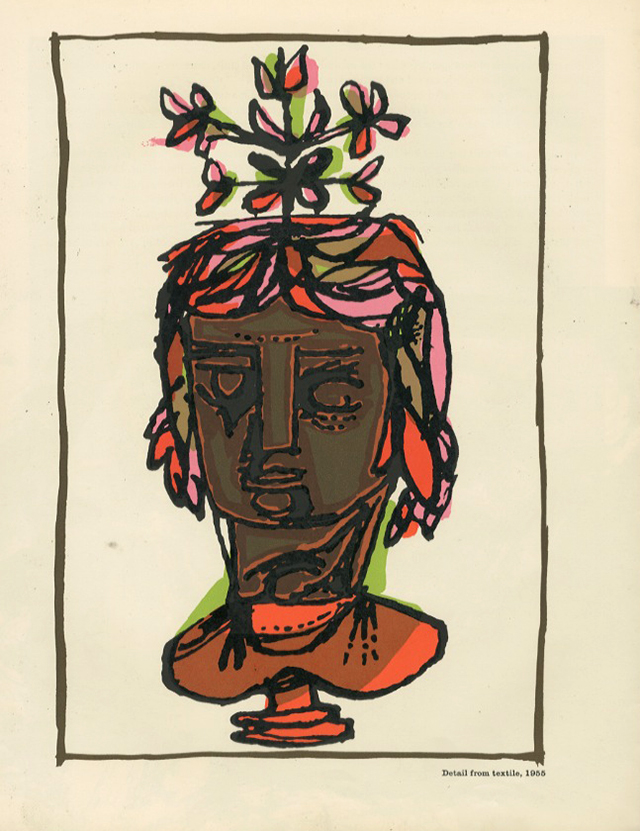
 Robert Stewart

Sheila Robinson 

MOTIF NO. 3 September 1959 – Cover by John Griffiths


A Front of Shops – John Griffiths 


MOTIF NO. 6 Spring 1961 – Cover by Hans Unger


 From Uganda  – Hans Unger

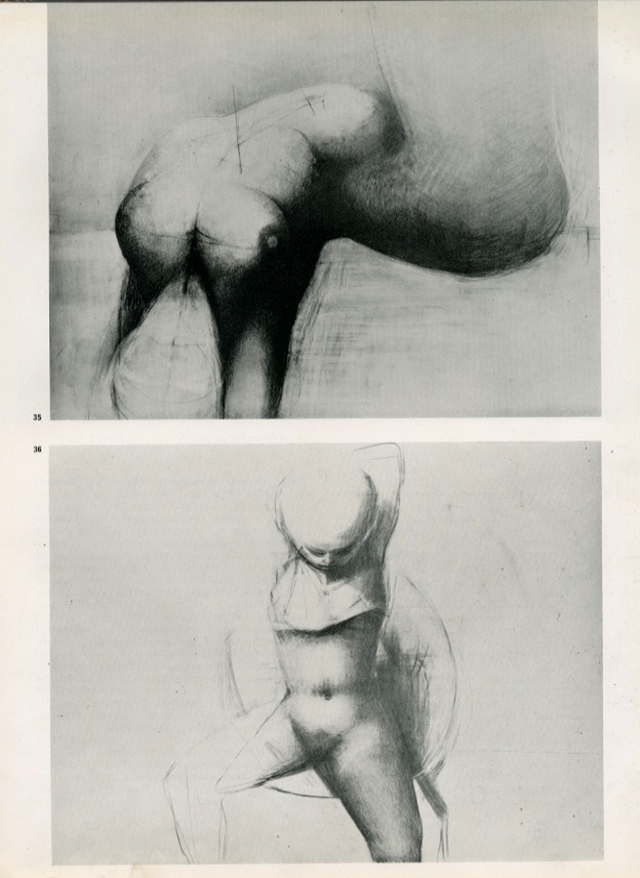
Untitled pencil drawings – Reg Butler 

Life Drawing – Claude Rogers 


Reportage spread – Ian Ribbons 


MOTIF NO. 7 Summer 1961 – Cover by Alan Davie


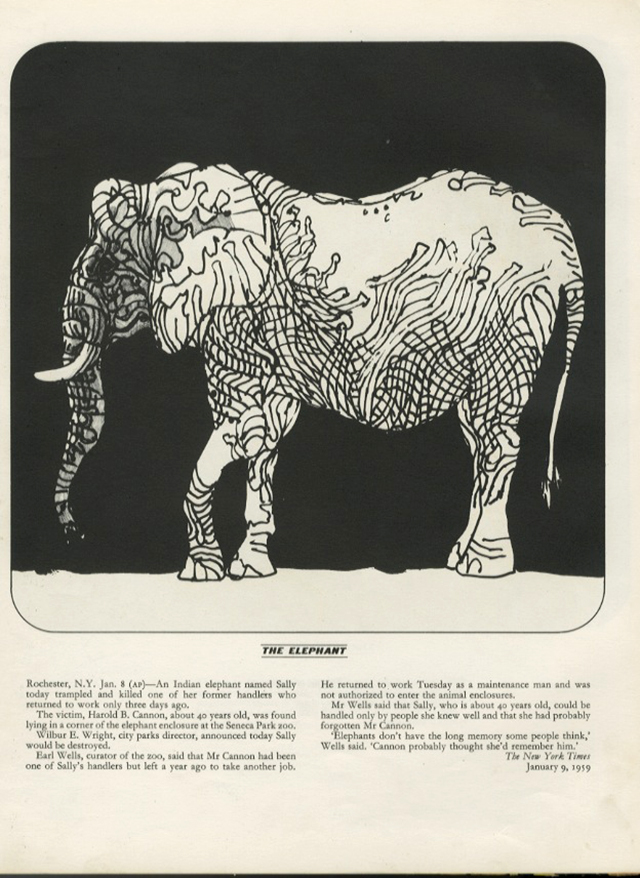
A Bestiary – the great Milton Glaser 


Joseph Low 

Reportage spread – Gerald Downes

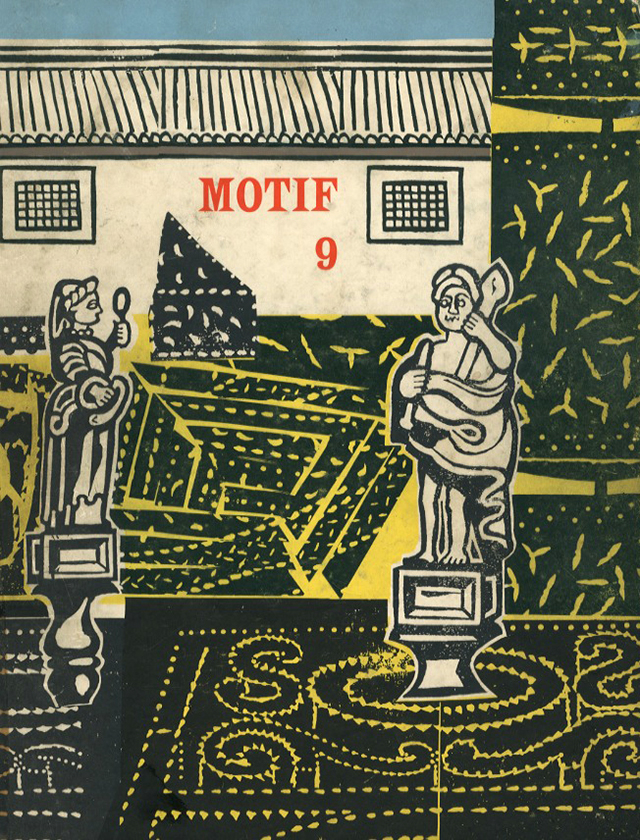
MOTIF NO. 9 Summer 1962 – Cover by Edward Bawden


Peniche – Edward Bawden 

Reportage spread – John Griffiths


Tuesday, 10 March 2015

Workspaces of the Staff and Students (IV)

This week: Illustration Corner!

It's a good long time since we did a 'Workspaces' feature and so to fill the vacuum left by our digital indolence, rather than focus on a particular individual's workspace, we thought we'd take you on safari to those various student habitats found in that area of our studio we call 'Illustration Corner'.

Don't worry, your tour guides know the area well and the natives are friendly. Have a look at the panoramic photograph below to familiarise yourself with the terrain and let the numbers act as signposts, leading you to the interior hinterland and the delights that await you there.

Have fun and remember to keep your legs crossed!

 DETAIL 1


  1. A startled native (Laura, seconds before she darted into the undergrowth)
  2. Arses
  3. Vincent (a graphic designer who lives quite happily in close proximity to a brush* of illustrators)
  4. Sophie (an illustrator and the brush* lookout, pictured emerging from her burrow)
  5. Grillust Hero No. 1 (the late, great John Peel)
*The correct collective noun for a group of illustrators.

 DETAIL 2

The calm before the storm. The ordered tranquility that clearly demonstrates this is the habitat of a graphic designer (in this case Vincent).

  1. Bait box (bait consumed, Vincent won't need to hunt for 48 hours)
  2. Beautifully soft, graphic designer's hands (courtesy Neutrogena Norwegian Formula)
  3. Soothing mood music to work by (Slayer – Seasons in the Abyss)
  4. Grillust Hero No. 2 (the later, greater Andy Warhol)
  5. A warm welcome to visitors

 DETAIL 3

  1. Some of Sophie's illustration work
  2. Dark room/store room/torture chamber
  3. Here be a monster
  4. One of Vincent's many posters for the legendary music venue The Brickyard

 DETAIL 4

Plunging deep into 'illustrator's country' we now reach the back corner, the territory of Jake and Maddy.

  1. Yeah, right...
  2. The Pompidoodle Centre
  3. Maddy's collection of Irn-Bru tartans. Maddy is a real Scotophile and likes nothing better than to hike along the great Scottish valleys. So far, she's enjoyed the delights of Glen Campbell, Glen Close and Glen Miller
  4. Either a green lady's chest or a painting by L S Lowry


 DETAIL 5


  1.  Who doesn't?
  2. Technically this statement is inaccurate as Illustrator's Corner is located in the South-East corner of our studio
  3. A small collection of dead frogs (Vincent's bait...)
  4. 'Bromance' (Jake and Ben)


DETAIL 6


  1. Something glinting tantalisingly in the distance (what could it be?)
  2. Jake's fringe (can be used for camouflage or as a display feature during his elaborate mating rituals)
  3. Maddy's archive of digital council tax letters
  4. Soothing mood music to work by (Rod McKuen – Jean)

Q: So what was glinting so tantalisingly in the distance?


A: 

  1. Maddy's half-eaten Easter Egg (a bit 'previous' as the photo was taken on March 9 2015)
  2. A complementary half-eaten pack of Ryvita (to assuage the guilt we suppose)
Next Time...
We glimpse what tomorrow will look like as we find out what's on Grillust staff member, 'Future' Dave Robert's desk.



Friday, 6 March 2015

The Shock of The Old (an occasional series)

It would be very foolish to think that only illustration and design produced in the last decade was of any interest to students. 

It could be argued (certainly by us) that many of the skills and techniques necessary to produce powerful, individual, memorable design and illustration are rapidly being lost by a generation of undergraduates.

Over the next few weeks we shall be selecting obscure examples from the past that showcase the possibilities of one (or more) aspect of the 'grammar' of design and illustration.

No.1 Dynamic Composition

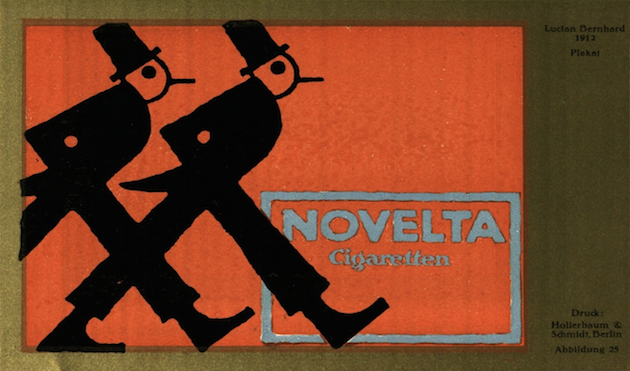
Design and illustration usually lives in a frame (page, screen, cover, poster etc.) The craft of arranging visual and typographic elements within this frame is called composition.

Compositions can be either either static or dynamic. 

Static compositions create a stable, very ordinary (often boring) aesthetic where elements live in a continually horizontal or vertical world. Dynamic composition is the polar opposite. 

Here the designer/illustrator creates a sense of movement (journey) by carefully taking the viewer's eye around the compositional frame.

Please have a good look at these examples, all around 100 years old, which come from the German magazine Das Plakat (The Poster) and date to circa 1910–1915!